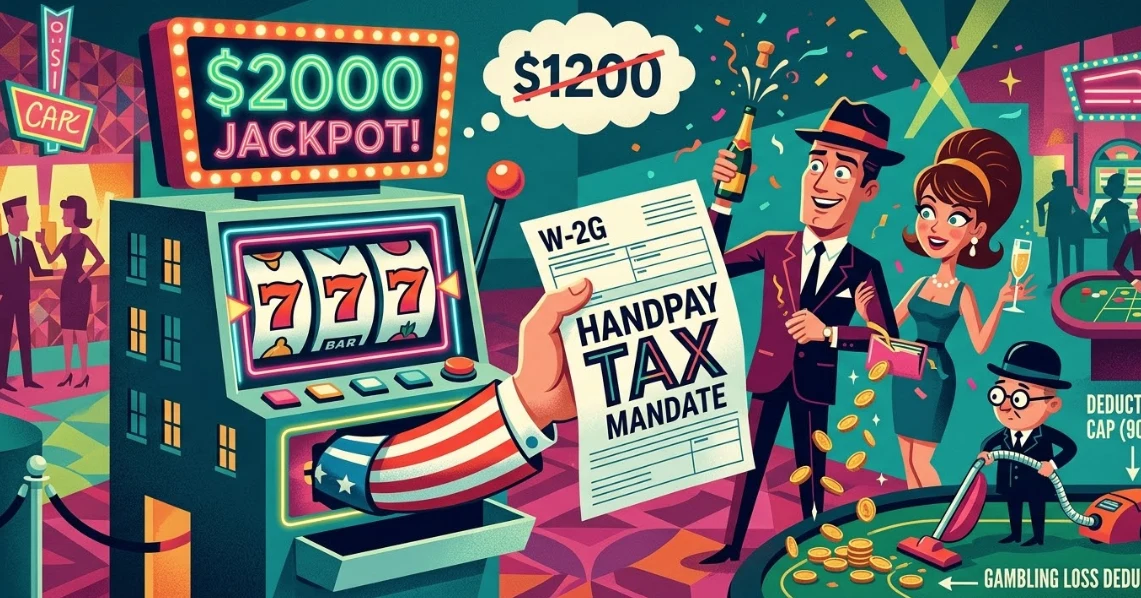
The reels align, the screen explodes in a frenzy of digital gold coins, and suddenly, the machine freezes. The music loops, but the spin button is dead. Instead of adding credits to your balance, the screen flashes two words that every slot player simultaneously loves and dreads: "Call Attendant."
Congratulations. You just hit a handpay.
For nearly five decades, hitting a jackpot of $1,200 or more meant an immediate halt to your gameplay. A floor attendant would arrive, check your ID, hand you a W-2G tax form, and physically count out your cash. But the gambling landscape is shifting. With sweeping tax changes taking effect in 2026, the definition of a handpay, and how much the government takes from it, is fundamentally changing.


Here is everything you need to know about the new slot thresholds, the hidden traps in the modern tax code, and how your zip code dictates your actual payout.
The New 2026 Reality: $2,000 is the New $1,200
Since 1977, the IRS mandated that any slot win of $1,200 or more triggered an automatic W-2G. Adjusted for inflation, that 1977 jackpot would be worth well over $6,000 today. The stagnant threshold turned a rule meant for massive wins into a logistical nightmare for modern casinos and a buzzkill for players.
Starting January 1, 2026, the IRS has officially raised the reporting threshold to $2,000.
This change is a massive operational victory. For players, it means fewer 30-minute delays waiting for a supervisor to verify a mid-tier jackpot on a high-volatility slot. For operators, it drastically reduces the administrative chokehold on the casino floor. However, the American Gaming Association and industry lobbyists originally pushed for a $5,000 limit. The $2,000 compromise is a step forward, but anyone playing high-denomination machines will still find themselves intimately familiar with the W-2G process.
The 90% Trap: When Uncle Sam Double-Dips
While the new $2,000 threshold feels like a win, the legislation that brought it into effect introduced a brutal caveat for frequent players.
Historically, gamblers could deduct 100% of their gambling losses against their winnings. If you won $50,000 over the year but lost $50,000, your taxable gambling income was zero. Under the new 2026 tax code, gambling loss deductions are capped at 90%.
This creates what accountants call "phantom income." If you break even with $50,000 in wins and $50,000 in losses, you can only deduct $45,000. You now owe federal taxes on $5,000 of money you do not actually have. For high-volume slot players, this fundamentally alters the math of casino gambling, effectively lowering the true Return to Player (RTP) of every machine on the floor.
State Taxes: Where You Play Matters
Federal taxes are just the first hurdle. The state where the casino is located also wants a piece of the action, and the rules vary wildly across the country.
-
The Zero Percent Havens: If you hit a handpay in Nevada, Florida, Texas, Washington, or South Dakota, you are in luck. These states have no state income tax. The money you receive after federal obligations is yours to keep.
-
The Flat Tax States: States like Pennsylvania and Indiana apply a flat tax rate to all gambling winnings, regardless of your overall income bracket. It is simple, predictable, and automatically factored into your tax liability.
-
The Progressive Punishers: Play in New York, California, or New Jersey, and your winnings are taxed based on your total income bracket. A massive handpay in these jurisdictions can easily bump you into a higher tax tier, meaning the state takes a significantly larger bite of your jackpot.
-
The Out-of-State Trap: Do not assume that flying to Las Vegas saves you from your home state's tax laws. If you live in a state with an income tax, you are still legally required to report out-of-state gambling winnings on your local return.
The Handpay Illusion and Player Protection
From a psychological standpoint, casinos love handpays. The bells, the flashing lights, and the physical counting of hundred-dollar bills create a spectacle that serves as free marketing to every other player on the floor.
But in the era of modern, high-volatility slots, a handpay is not always a life-changing event. A $2,500 win on a $25-per-spin machine is simply a 100x multiplier. It is a solid hit, but far from a traditional jackpot. Players must remain vigilant about their bankroll management. Celebrating a handpay by immediately feeding the cash back into the machine is a common pitfall, especially when you consider that a portion of that cash technically belongs to the IRS.
What Did We Learn?
The bump to a $2,000 reporting threshold is a welcome modernization for an industry that has been bound by 1970s tax logic for far too long. It means smoother gameplay, less paperwork, and a more seamless casino experience. Just remember that the house always has an edge, and the IRS always has a form. Keep your ID handy, track your wins and losses meticulously, and understand the tax laws of the state you are playing in. After all, it is only a true jackpot if you actually get to keep it.